Image 1 of 4
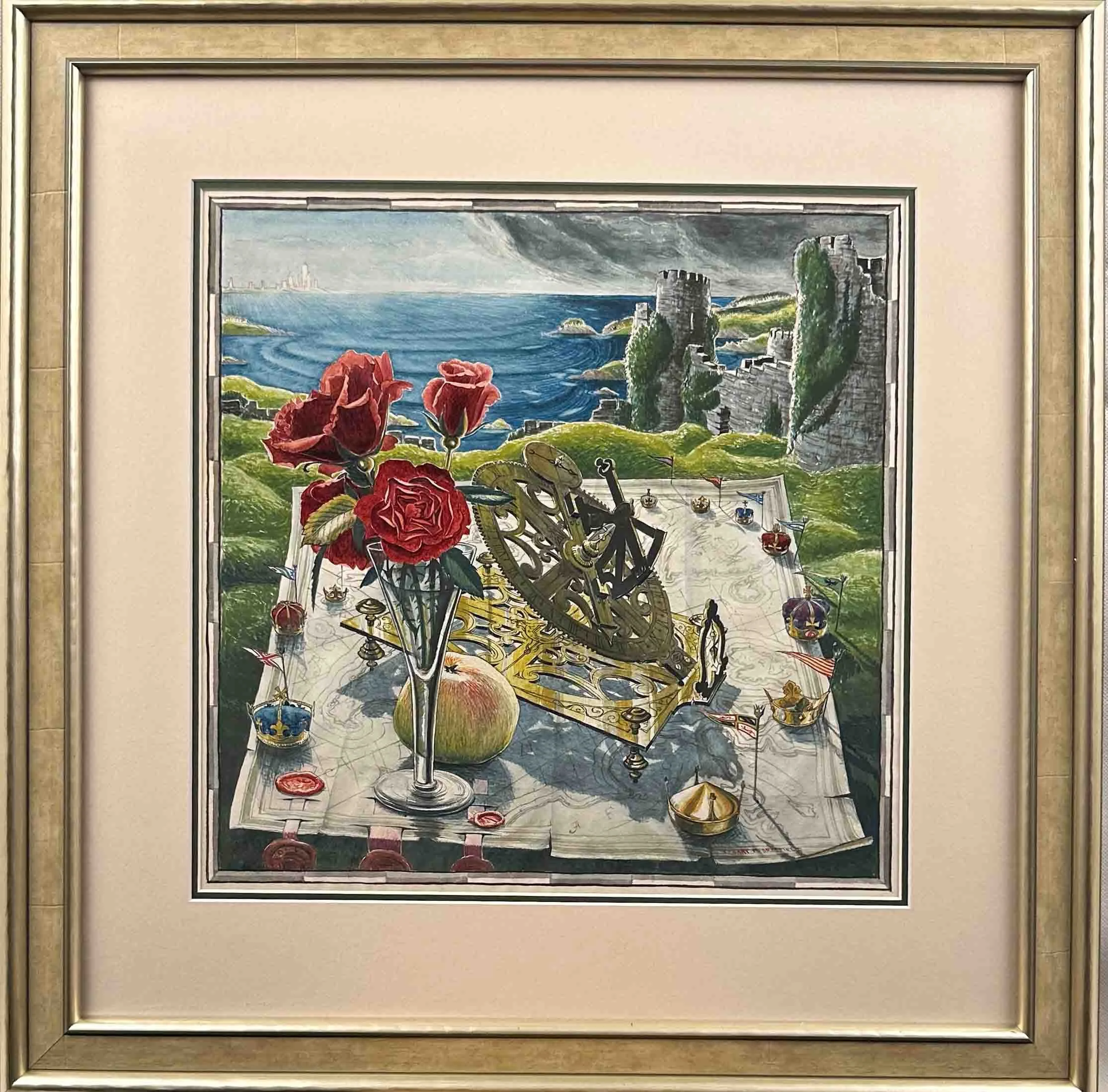 Image 2 of 4
 Image 3 of 4
 Image 4 of 4
Stuart Maxwell Armfield 1916 – 1999
Offered publicly for the first time in nearly 80 years
Armfield exhibited at the RA, RI, RWS and ROI and had his own gallery in Looe in Cornwall. This painting reflects his surreal or exploratory symbolism phase. Bought from the artist directly in the mid 1940’s, these British experimental paintings from that period are scarce and difficult to acquire.
The Kingdom of Wessex is a luminous and contemplative work, showcasing his distinctive fusion of classical structure and modernist symbolism. The painting presents a dreamlike landscape where architectural forms and symbolic objects are suspended in a serene, infinite space. Its composition evokes a mythical vision of the ancient Anglo-Saxon kingdom, yet transcends historical narrative to offer a poetic meditation on identity, time, and place.
Armfield’s meticulous craftsmanship and philosophical approach place him within the lineage of British surrealism, though his work remains uniquely his own. Influenced by his cousin, the Arts and Crafts painter Maxwell Ashby Armfield, Stuart developed a style that often features recurring motifs—chessboards, vessels, keys—imbued with metaphorical resonance and arranged with architectural precision.
Armfield left a successful career in film design to pursue painting full-time in the 1940s. His work was exhibited at the Royal Academy, the St Ives Society of Artists, and internationally, yet remains relatively under-recognised in the current market. The Kingdom of Wessex is a rare opportunity to acquire a work that bridges visionary clarity with the introspective depth of 20th-century surrealism.
For collectors seeking a piece of British modernism that is both intellectually rich and visually refined, this painting offers enduring appeal.